Connecting DSPs and Ad Tech to AI Workflows: A Practical Integration Guide
Connecting DSPs and Ad Tech to AI Workflows: A Practical Integration Guide
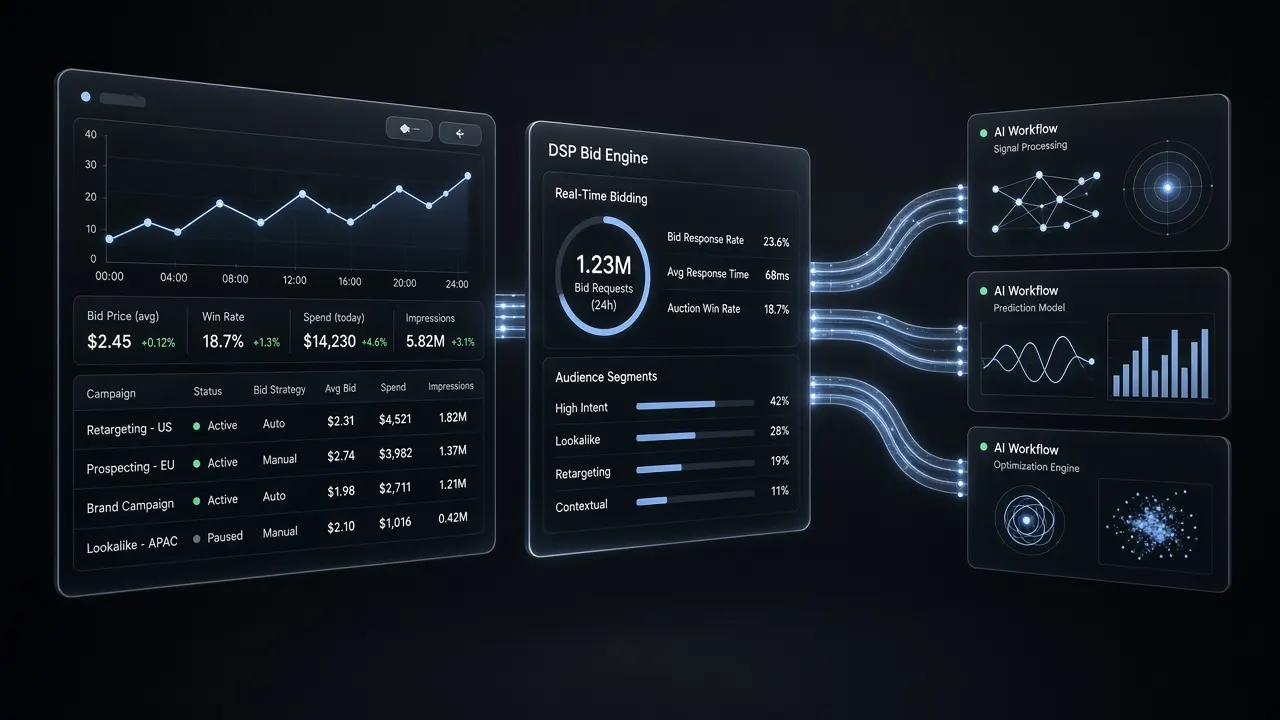
Stronger performance in programmatic rarely comes from single tactics. It comes from a well designed AI ad tech integration that connects your data, models, and decisioning to the platforms where spend happens. This tutorial shows ad ops and engineering teams how to connect DSPs to AI, automate key workflows, and deploy a reliable feedback loop from impression to conversion.
For related guidance, see AI ad creative automation case study, AI performance marketing tools, and ad tech integration services.
What you will build
- A secure integration layer between AI services and DSP APIs.
- A standardized data model and feature store for training and inference.
- Programmatic ads automation for budgets, bids, creatives, and audiences.
- A closed-loop measurement system to learn and improve continuously.
Reference architecture for AI ad tech integration
Use this blueprint as a starting point. Adapt names to the DSPs you use, such as DV360, The Trade Desk, Amazon DSP, or Xandr.
- Data sources: web and app events, CRM, offline conversions, product feed.
- Event ingestion: SDKs or server-side collectors streaming to a queue.
- Processing: stream jobs for real-time features, batch jobs for aggregates.
- Feature store: online for low-latency inference, offline for training parity.
- Model serving: scalable inference endpoint returning scores or actions.
- Integration layer: authenticated clients that call DSP APIs and webhooks.
- Orchestration: scheduler for recurring jobs and dependency management.
- Observability: logs, metrics, and alerts for spend, delivery, and model health.
Before you start: prerequisites
- DSP API access and credentials with the right scopes. Some features require allowlisting.
- Secrets management for OAuth tokens and keys with rotation policies.
- Data contracts for events: impression, click, view-through, conversion, and suppression.
- Consent capture and propagation across your stack to satisfy privacy requirements.
- Environments: dev, staging, prod with representative test accounts and budgets.
Choose the right integration pattern
There are three common patterns to connect DSP to AI. Pick the simplest that delivers your goals, then iterate.
| Batch | Hours to daily | Audience sync, budget rebalancing, creative refresh | Highest stability. Great first step for programmatic ads automation. |
| Near real-time | Minutes | Bid and cap adjustments, negative keyword or site lists | Use queues and scheduled workers. Good trade-off of impact vs. complexity. |
| Real-time | Milliseconds | In-path decisioning, dynamic creative selection | Requires strict SLOs and specialized endpoints. Usually a phase 2. |
Step 1: Secure authentication and connectivity
Centralize secrets and enforce least privilege. Use service accounts where available.
# Minimal credential loader with rotation support
import os
from datetime import datetime, timedelta

class TokenStore:
    def __init__(self, backend):
        self.backend = backend  # e.g., cloud secret manager

    def get(self, key):
        return self.backend.read(key)

    def set(self, key, value, ttl_hours=12):
        self.backend.write(key, value, expires=datetime.utcnow() + timedelta(hours=ttl_hours))

# OAuth 2.0 client for a generic DSP
class DSPClient:
    def __init__(self, token_store, client_id, client_secret, auth_url, api_base):
        self.store = token_store
        self.client_id = client_id
        self.client_secret = client_secret
        self.auth_url = auth_url
        self.api_base = api_base

    def token(self):
        tok = self.store.get("dsp_access_token")
        if tok and tok["expires"] > datetime.utcnow():
            return tok["value"]
        # fetch a new token
        # ... request omitted
        new_tok = {"value": "token", "expires": datetime.utcnow() + timedelta(hours=1)}
        self.store.set("dsp_access_token", new_tok)
        return new_tok["value"]
Implement backoff and retries, expose idempotency keys for mutation endpoints, and log request IDs returned by the DSP for reconciliation.
Step 2: Design a data model and feature store
Unify identifiers and define stable keys for your features. Typical entities:
- User or household: hashed email or customer ID with consent flags.
- Device or browser: advertising identifiers where permitted.
- Campaign, insertion order, line item, and creative: platform entities.
- Event: impression, click, view, pageview, add-to-cart, purchase.
Use a feature store to serve consistent features to both training and inference. Examples: eligibility features, recency and frequency, predicted conversion probability, and creative affinity scores.
Step 3: Build the event pipeline
Instrument your apps and sites to emit typed events with consent status. A minimal schema:
{
  "event_id": "uuid",
  "event_type": "impression|click|conversion",
  "timestamp": "ISO-8601",
  "user_key": "hashed_email|customer_id",
  "device_id": "idfa|gaid|browser_id",
  "campaign_id": "string",
  "line_item_id": "string",
  "creative_id": "string",
  "site": "domain",
  "placement": "string",
  "value": 123.45,
  "currency": "USD",
  "consent": { "tc_string": "...", "us_privacy": "..." }
}
Deduplicate by event_id, enrich with geo and device info, and route to both your warehouse and streaming consumers. Filter or transform events based on consent and data usage policies before exporting to any ad platform.
Step 4: Train models aligned to activation levers
Pick models that map directly to what your DSP lets you control.
- Bid or budget modifiers: predict conversion probability or expected value. Use monotonic constraints to keep outputs within safe ranges.
- Creative selection: use contextual bandits to explore and exploit variants.
- Audience eligibility: score users or segments for inclusion or suppression.
Log model versions and features used. Keep offline and online feature definitions in sync to prevent training-serving skew.
Step 5: Serve a decisioning API
Host a low-latency service that returns a recommended action the integration layer can translate into DSP updates.
# Lightweight scoring service (illustrative)
from fastapi import FastAPI
import joblib

app = FastAPI()
model = joblib.load("model.joblib")

@app.post("/score")
def score(payload: dict):
    x = [payload.get("recency"), payload.get("frequency"), payload.get("value")]
    p_conv = float(model.predict_proba([x])[0][1])
    # map to an action space the DSP can accept
    action = {
        "bid_modifier": max(0.8, min(1.2, 1 + (p_conv - 0.1)))
    }
    return {"p_conv": p_conv, "action": action}
Version the endpoint and enforce SLAs that match your chosen pattern: minutes-scale for near real-time or sub-100 ms for in-path decisioning.
Step 6: Connect to DSP APIs and objects
Most DSPs expose endpoints for entities like advertisers, campaigns, insertion orders, line items, creatives, and audiences. The integration layer translates model outputs into safe mutations.
Example: audience sync
POST /v1/audiences/batch
{
  "advertiser_id": "12345",
  "audience_id": "67890",
  "operation": "UPSERT",
  "identifiers": [
    { "type": "EMAIL_SHA256", "value": "abc..." },
    { "type": "MAID", "value": "idfa:..." }
  ],
  "metadata": { "source": "feature_store", "consent": true },
  "idempotency_key": "uuid-123"
}
Example: line item bid and budget adjustments
PATCH /v1/line_items/LI-001
{
  "bid_strategy": { "type": "MANUAL", "modifier": 1.08 },
  "daily_budget": 1500,
  "pacing": { "type": "EVEN" },
  "targeting_updates": { "exclusions": { "sites": ["lowquality.example"] } },
  "idempotency_key": "uuid-456"
}
Example: creative rotation informed by bandits
POST /v1/line_items/LI-001/creative-assignments
{
  "assignments": [
    { "creative_id": "CR-A", "weight": 0.55 },
    { "creative_id": "CR-B", "weight": 0.30 },
    { "creative_id": "CR-C", "weight": 0.15 }
  ],
  "idempotency_key": "uuid-789"
}
Respect platform-specific constraints like minimum budgets, valid enum values, and allowable change frequencies. Cache platform metadata to validate requests before sending.
Step 7: Ad tech workflow automation
Automate recurring jobs to reduce manual ops and speed up learning. This is the core of ad tech workflow automation.
- Daily: rebuild audiences, rebalance budgets across campaigns, refresh creative weights.
- Hourly: adjust pacing and bid modifiers within guardrails, update negative lists.
- Event driven: move a user to a suppression list on conversion, pause under-delivering line items.
# Orchestration pseudo-graph (e.g., Airflow)
from datetime import timedelta

def job_daily_audience_sync():
    # 1) query feature store  2) build batch  3) call DSP audience API
    pass

def job_hourly_pacing():
    # 1) read delivery  2) compute drift  3) patch budgets within bounds
    pass

SCHEDULE = {
    "daily_audience_sync": {"cron": "0 2 * * *", "task": job_daily_audience_sync},
    "hourly_pacing": {"every": timedelta(hours=1), "task": job_hourly_pacing}
}
Guardrails matter. Enforce max change per hour, min and max bids, and stop-loss rules when CPA spikes or delivery stalls.
Step 8: Measurement and feedback
Create a single source of truth for performance and learning.
- Attribution: last touch for operational speed, model-based for planning. Compare both.
- Incrementality: geo or audience holdouts for causal lift. Schedule continuously.
- MMM: use aggregated data for channel-level budget allocation.
Feed conversions and revenue back to the feature store to update labels and features. Retrain on a fixed cadence, promote models with canary tests, and record lineage for audits.
Step 9: Monitoring and alerting
Operational reliability is as important as model quality.
- Delivery health: spend vs. plan, impression goals, win rate.
- Data freshness: lag on events, delayed conversions, audience sync success rate.
- Model serving: latency, error rate, and drift of key features.
- API reliability: rate limits, 4xx and 5xx spikes, idempotency conflicts.
Alert on thresholds and include auto-remediation, such as reverting to safe defaults or pausing volatile line items until human review.
Step 10: Privacy, consent, and platform governance
Compliance cannot be bolted on later. Build it into the design.
- Honor consent strings and regional signals when exporting any user-level data.
- Avoid storing raw PII in ad systems. Use hashed, salted identifiers where permitted.
- Maintain data retention policies and support user access or deletion requests.
- Document data usage restrictions for each DSP and verify them in code.
Deployment blueprint
- Dev: sandbox advertisers with fake spend and synthetic data.
- Staging: low budgets, full integration paths, synthetic failures.
- Prod: canary on a subset of line items, then progressive rollout.
Always include a rollback plan that reverts to manual settings or stable heuristics.
End-to-end example: from score to DSP update
import requests, time, uuid

FEATURE_STORE = "https://features.internal/online"
SCORER = "https://ai.internal/score"
DSP_API = "https://dsp.internal/v1"

# 1) Pull fresh delivery metrics
r = requests.get(f"{DSP_API}/reports/delivery?window=1h")
delivery = r.json()

# 2) For each active line item, compute pacing drift
updates = []
for li in delivery["line_items"]:
    planned = li["planned_spend"]
    actual = li["actual_spend"]
    drift = (planned - actual) / max(planned, 1)
    if abs(drift) > 0.1:  # beyond 10%
        # 3) Get features and score
        feats = requests.get(f"{FEATURE_STORE}/li/{li['id']}").json()
        score = requests.post(SCORER, json=feats).json()
        mod = score["action"]["bid_modifier"]
        # 4) Prepare safe patch
        updates.append({
            "id": li["id"],
            "bid_strategy": {"type": "MANUAL", "modifier": min(1.2, max(0.8, mod))}
        })

# 5) Chunked PATCHes with idempotency
for chunk_start in range(0, len(updates), 50):
    chunk = updates[chunk_start:chunk_start+50]
    headers = {"Idempotency-Key": str(uuid.uuid4())}
    res = requests.patch(f"{DSP_API}/line_items:batchPatch", json={"updates": chunk}, headers=headers)
    if res.status_code >= 400:
        # retry with backoff
        time.sleep(2)
Extend this skeleton with structured logging, observability, retries, and a persistent job registry.
Common pitfalls and how to avoid them
- Training-serving skew: define features once and reuse the same transformations online and offline.
- Overactive automation: add guardrails and change budgets slowly to protect delivery.
- Ignoring platform constraints: validate payloads locally against cached DSP metadata.
- Unreconciled reporting: reconcile platform-reported conversions with internal events daily.
- Security gaps: centralize secret storage, rotate tokens, and restrict scopes.
Implementation checklist
FAQ
Why connect DSPs to AI workflows instead of using native platform AI?
Cross-platform orchestration lets you unify creative testing, audience logic, and reporting. AI workflows can act on signals from CRM, product data, and multiple ad channels at once.
What is the hardest part of DSP and AI workflow integration?
Identity mapping and latency. Plan for stable IDs, rate limits, and fallback rules when API calls fail or data arrives late.
How do you start DSP integration without breaking live campaigns?
Run read-only syncs first, then shadow-mode recommendations, then limited budget tests. Never let automation change bids or budgets without guardrails and rollback.
- Define entities, event schema, and data contracts with owners.
- Stand up feature store with online and offline stores in parity.
- Deploy model serving with versioning, SLOs, and monitoring.
- Build integration clients with retries, idempotency, and validation.
- Ship batch audience sync and budget automation first.
- Add near real-time adjustments and creative bandits next.
- Close the loop with attribution, incrementality, and MMM.
Conclusion
Connecting DSPs and ad tech to AI workflows is most effective when you start simple, automate the highest-leverage tasks, and prove reliability early. With the patterns and code in this guide, you can launch a robust integration that lifts performance and reduces manual work. If you need a partner to design, implement, and operate your integration, our team is ready to help.
Ready to Transform Your Marketing, Branding & Advertising Strategy?
Marketing - marketing strategies that drive real connections and lasting impact.
Advertisement - bold ideas and unforgettable campaigns powered by intelligent automation.
Ad Tech - data-driven power for every campaign with advanced tracking and optimization.
Branding - your story, instantly distinct and emotionally true through enhanced creativity.
Aashish Kumar
AI Automation Expert