From Chatbots to Coworkers:OpenAI's Dots Could Change How We Work With AI
For years, using AI has followed a pretty predictable pattern. You open a chatbot. You type a prompt. You get an answer. Then you decide what to do next.
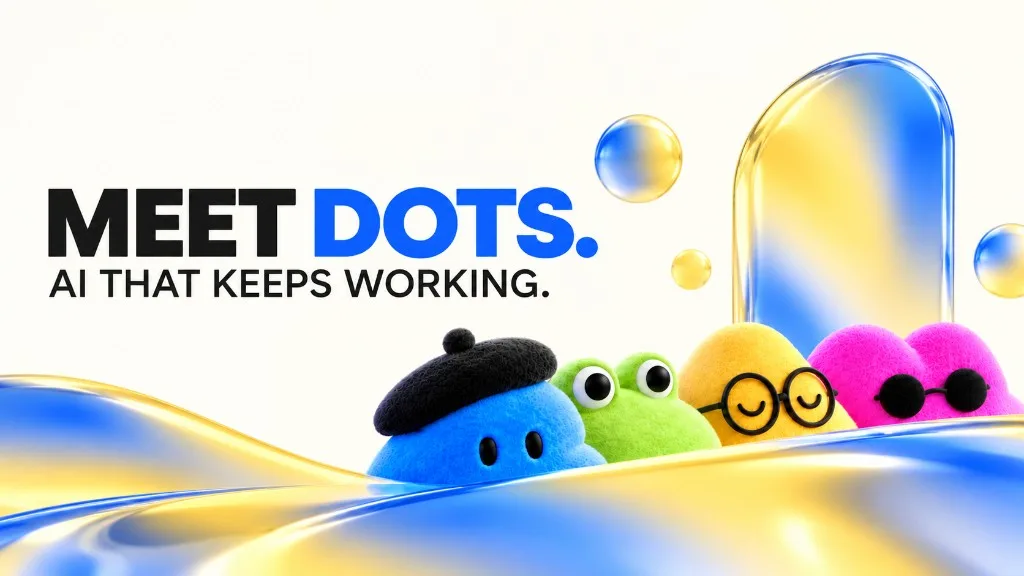
OpenAI wants to change that relationship. On September 30, OpenAI introduced dots, a new kind of AI agent designed to keep working toward your goals even when you are not actively chatting with it. And that difference is bigger than it sounds.
The AI That Doesn't Stop When You Leave
Think about how you normally use AI. You might say: “Research these competitors.” The AI gives you the research. Then you say: “Turn this into a presentation.” It creates the presentation. Then you realise something is missing, so you ask another question. You are still driving every step.
Dots are designed around a different idea. You give the agent a goal, provide the context and connect the tools it needs. It can then continue working toward that goal, including in the background. That changes the fundamental relationship.
Chatbot: “Tell me what you need.” Agent: “Give me something that needs to get done.” And that is where things start getting interesting.
Your AI Could Actually Follow the Work
Imagine a developer whose dot notices a bug being discussed in Slack and begins investigating it. Or a product team whose dot keeps launch materials updated as project requirements change. Or a creator whose dot takes an interview transcript and turns it into potential clips, show notes and social content.
The important part isn't that AI can perform these individual tasks. We've known that for a while. The interesting part is that the AI can stay with the task. It can understand what needs to happen next, work across connected tools and bring decisions back to you when necessary. That is a very different workflow.
And This Could Get Really Interesting for Creators
Think about a content team. Today, the process might look like: Interview → transcript → find clips → write captions → create posts → schedule everything. With an agent, that could become: Interview → give the project to your dot → review what it prepared.
The human still makes the creative decisions. But AI takes on more of the work surrounding those decisions. And that distinction matters.
The future isn't necessarily: AI creates everything. It could be: AI handles everything around the thing you actually care about creating.
The Biggest Shift Is Not Intelligence. It's Time.
We've spent years asking whether AI can write better, code better, design better or reason better. Dots introduce another question: What happens when AI doesn't just become smarter, but stays with the task?
A traditional chatbot is mostly conversation-based. You ask something. It responds. The interaction ends. An agent can be goal-based. You give it something to accomplish, and it can continue making progress toward that objective.
That's a fundamental change. The AI isn't just living inside a conversation anymore. It starts becoming part of the workflow itself.
But AI Doesn't Get Unlimited Control
This is an important part of the concept. Users can decide which apps an agent can access, set rules, monitor its activity and determine when certain actions require approval.
The idea isn't: “Give AI complete control.” It's closer to: “Give AI a job, but define the boundaries.” And as agents become more capable, those boundaries will become increasingly important.
Are We Moving Beyond the Chatbot Era?
Maybe. The bigger change isn't simply that AI can now perform more tasks. It's that the unit of interaction is changing.
For years, the basic unit was the prompt. Now, we're moving toward the goal. You don't necessarily need to tell AI every individual step. You tell it what needs to happen. And AI starts figuring out the work between point A and point B.
The Bigger Picture
Dots are still an early step, but the idea behind them points toward a much bigger shift in how we interact with AI. The next generation of AI may not be defined by how quickly it answers a question. It may be defined by how much work it can carry forward without you.
Because the most valuable AI might not be the one that gives you the best answer. It might be the one that lets you say: “Here's what needs to happen. I'll check back when it's ready.” And walk away.
Ready to Transform Your Marketing, Branding & Advertising Strategy?
Marketing - marketing strategies that drive real connections and lasting impact.
Advertisement - bold ideas and unforgettable campaigns powered by intelligent automation.
Ad Tech - data-driven power for every campaign with advanced tracking and optimization.
Branding - your story, instantly distinct and emotionally true through enhanced creativity.
Yuvraj Singh Karki
AI Automation Expert