Your Entire Content LibraryCould Become a Searchable Memory
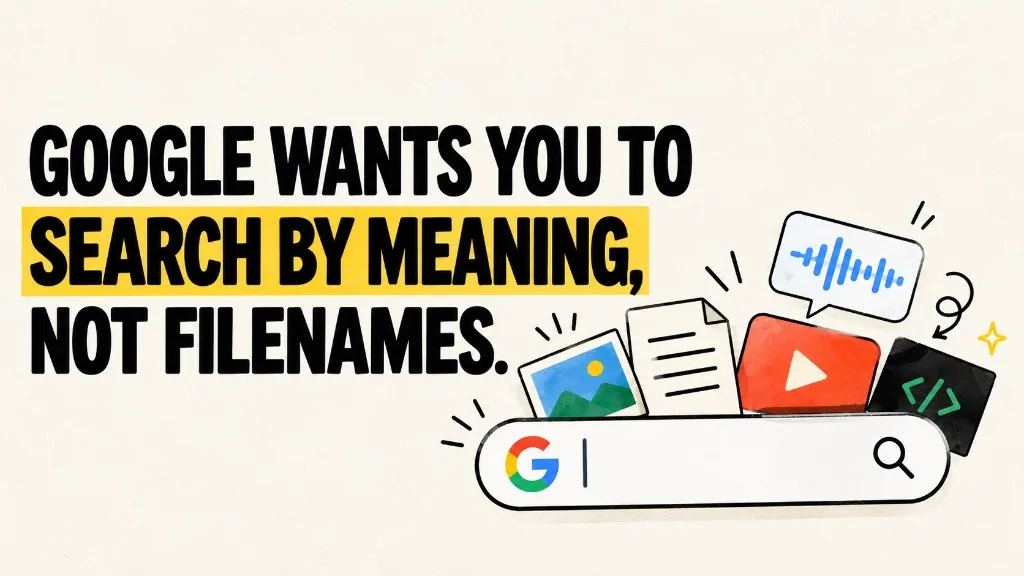
Think about how much content a creator or marketing team produces every month.
There are campaign videos, behind-the-scenes clips, client meetings, interviews, voice recordings, design references, presentations, and hundreds of files saved across different folders. Over time, this becomes a massive library of creative work.
The problem is that creating content is only half the job. Finding something you created weeks or months ago can be just as time-consuming.
Now, picture a different workflow.
You need a clip from a campaign discussion six months ago. You do not remember the filename, the folder, or the exact date. All you remember is that the team discussed the campaign launch.
Instead of manually searching through folders, you could describe the moment you are looking for. A search system built using multimodal embeddings could compare that description with indexed content and surface relevant results, depending on how the system is configured.
The same principle could help teams locate a particular scene in a video, find an image that matches a visual reference, or retrieve a document connected to an earlier conversation.
Your library would no longer be just a collection of files. It could become a searchable record of your work.
Why This Matters for Creators and Marketing Teams
For creators, time spent searching is time taken away from creating.
A video editor might need a particular reaction shot from hours of footage. A social media manager might be looking for an old campaign reference. An agency could need to revisit a client discussion or find the original asset behind a successful advertisement.
In each case, the challenge is not necessarily a lack of content. It is finding the right content at the right moment.
Semantic search can help bridge that gap by connecting a search query to the meaning of the material being searched. Multimodal search extends this idea across different media types, making it possible to build systems that connect descriptions, visuals, speech, and other information.
For teams managing years of creative assets, that could mean less time digging through folders and more time putting existing work to use.
It could also make old content more valuable. A clip that was difficult to locate might become useful for a new campaign, a fresh edit, or a completely different creative idea.
The Interesting Part Is That It Can Run Locally
One of EmbeddingGemma 2's notable characteristics is its compact design, which makes local deployment a potential option on suitable devices.
Why does that matter?
Running models locally can reduce dependence on sending every piece of information to a remote service. Depending on the hardware and application, it can also offer benefits for latency, privacy, and operating costs.
For businesses working with internal meetings, unreleased campaigns, or sensitive creative assets, those considerations are important.
However, the model does not automatically organize or search every file on your device. A practical application still needs to process and index the content, connect the model to a search system, and retrieve relevant results. Video and audio may also require additional processing before they can be searched effectively.
The model provides a building block for that experience, rather than a complete search application on its own.
We May Be Moving Beyond Search as We Know It
For years, we have learned to organize our digital lives around filenames, folders, tags, and carefully structured libraries. We have adapted our habits to suit the limitations of the tools we use.
Multimodal AI points towards a different possibility: tools that adapt more closely to how people naturally remember information.
We rarely remember a file by its exact name. We remember what was happening in it, what someone said, what it looked like, or why it mattered.
That is what makes this development interesting. It brings digital search a little closer to the way human memory works, connecting information through context rather than relying entirely on labels.
For creators and marketers, that could make years of accumulated work easier to revisit, reuse, and build upon.
The next big improvement in creative workflows might not come from producing more content. It might come from making the content we already have easier to find.
Because sometimes, the most useful thing AI can do is not create something new.
It is help you find something you already made.
Ready to Transform Your Marketing, Branding & Advertising Strategy?
Marketing - marketing strategies that drive real connections and lasting impact.
Advertisement - bold ideas and unforgettable campaigns powered by intelligent automation.
Ad Tech - data-driven power for every campaign with advanced tracking and optimization.
Branding - your story, instantly distinct and emotionally true through enhanced creativity.
Satyam Mishra
AI Automation Expert